Best of
The Best Coffee Beans for Pour-Over in 2027
The 2027 lineup of coffee beans for pour-over, ranked on clarity, sweetness, and how they hold up across V60, Chemex, and Kalita brewers.
The short answer
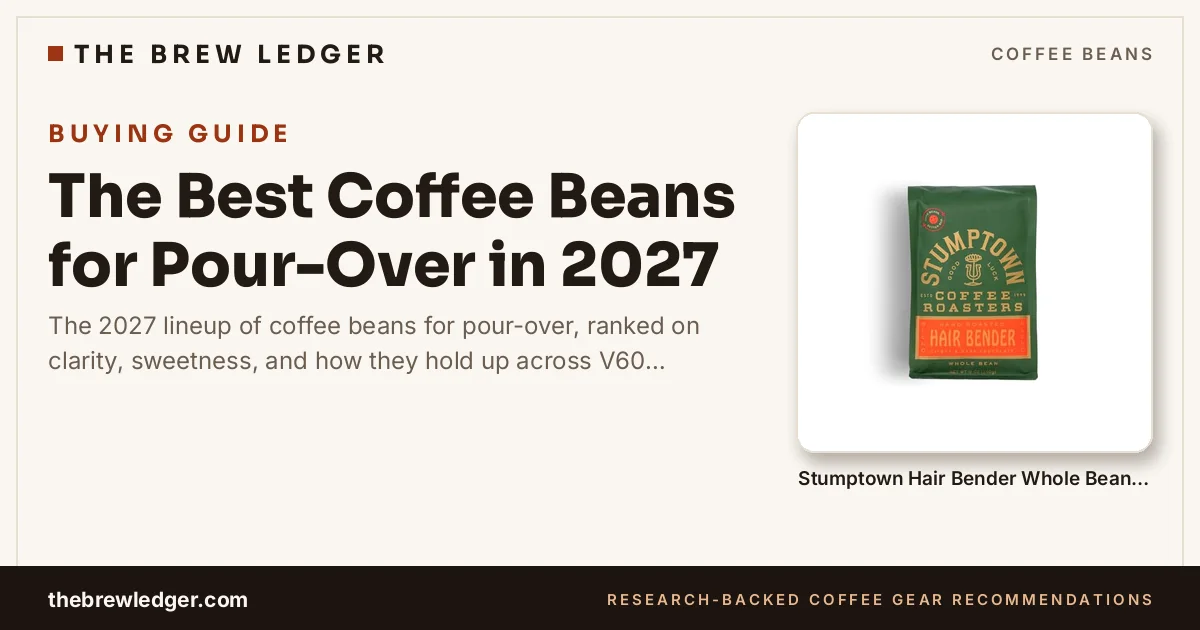
For pour-over, buy a fresh medium roast and let the filter do the clarifying. Stumptown Hair Bender is the best specialty choice, with sweetness that survives a slow pour without oily dark-roast residue. Kicking Horse Three Sisters is the everyday pick, and Lavazza Qualita Rossa is the budget bag that keeps a daily pour-over habit affordable. Compare with the full best coffee beans ranking and the coffee bean buying guide for roast and freshness guidance.
Pour-over shows everything, including roast defects, so the bean choice matters more here than in a press.
Pour-over beans at a glance
Ranked on clarity, sweetness, and value
| Product | Blend | Roast level | Origins | Bag size | Tasting notes |
|---|---|---|---|---|---|
| Stumptown Hair Bender Whole Bean Coffee | 100% Arabica, multi-origin blend | Medium | Latin America, Indonesia, Africa | 12 oz, whole bean | Sweet citrus, dark chocolate, raisin, per Stumptown |
| Kicking Horse Three Sisters Medium Roast | 100% Arabica | Medium | Indonesia, Central and South America | 2.2 lb (1 kg), whole bean | - |
| illy Classico Whole Bean Coffee | 100% Arabica, nine origins | Medium (Classico) | Nine growing regions, blended in Italy | - | Caramel, orange blossom, jasmine, per illy |
| Lavazza Qualita Rossa Whole Bean Coffee | Arabica and Robusta | Medium | Brazil, Africa, Southeast Asia | 2.2 lb (1 kg), whole bean | Chocolate and dried fruit, per Lavazza |
Swipe sideways to compare all columns

01Best specialty pour-over
Stumptown Hair Bender Whole Bean Coffee
- Blend: 100% Arabica, multi-origin blend
- Roast level: Medium
- Origins: Latin America, Indonesia, Africa
Stumptown's flagship medium roast works across espresso and drip and keeps its sweetness without the oily surface of a dark roast, which is exactly what a pour-over needs: a clean cup where the filter does the clarifying, not the roast. The 12 oz bag is small for a busy household, and dark-roast drinkers will miss the heavier body.

02Best everyday medium roast
Kicking Horse Three Sisters Medium Roast
- Blend: 100% Arabica
- Roast level: Medium
- Origins: Indonesia, Central and South America
A 100 percent Arabica medium roast from Indonesia, Central, and South America, certified Organic, Fairtrade, and Kosher, with sweet tobacco, stone fruit, and cocoa notes. Its record lists pour-over explicitly among the methods it suits, and it shines in filter brewing rather than espresso, where its crema is modest. The 2.2 lb bag suits a household that pours daily, and the same blend also comes in a 10 oz bag for a solo pour-over drinker.

03Smoothest all-Arabica pour
illy Classico Whole Bean Coffee
- Blend: 100% Arabica, nine origins
- Roast level: Medium (Classico)
- Origins: Nine growing regions, blended in Italy
The medium Classico roast is balanced and never harsh, which suits a slow pour-over as well as it suits one-touch lattes, and the pressurized can protects aroma until it is opened. The catch is cost per cup: an 8.8 oz can empties quickly when pour-over is the daily method, and all-Arabica means a lighter body than the blends here.

04Best budget pour-over
Lavazza Qualita Rossa Whole Bean Coffee
- Blend: Arabica and Robusta
- Roast level: Medium
- Origins: Brazil, Africa, Southeast Asia
A medium roast at a budget per-pound price, in a 2.2 lb bag, with enough Robusta for body through a paper filter. This is the bean to keep on hand when pour-over is the household's daily brew and the bag turns over weekly. Expect blend consistency rather than origin character.
Questions, answered
Should pour-over beans be light, medium, or dark?
Medium is the safest starting point: light roasts can taste sharp through a paper filter, and very dark roasts turn oily and bitter in a slow pour. Once a medium roast tastes right, moving lighter is the way to explore origin character.
Does grind size matter more than the bean for pour-over?
Both matter, but grind is the faster fix: too fine and the drawdown stalls and over-extracts, too coarse and the cup tastes thin. Start medium-fine, adjust one step at a time, and change the bean only after the grind is right.
How fresh should pour-over beans be?
Roasted within the last 2 to 4 weeks is the sweet spot. Very fresh beans, under a week, degas excessively and can stall the drawdown; beans over two months old taste flat no matter the brewer.
Can I use espresso beans for pour-over?
Yes, if they are a medium roast. Dark espresso roasts tend to taste bitter and ashy through a filter, while medium espresso blends like Black Cat pour cleanly. The roast level matters more than the label on the bag.