Head to head
Bodum Chambord vs Espro P7: Classic Glass Against Modern Steel
Bodum Chambord vs Espro P7 compared on filtration, heat retention, material, and price: the classic glass press against the double-filtered vacuum-insulated steel press.
Quick verdict
Our recommendation
Buy the Bodum Chambord if you want the classic French press experience: the chrome-and-glass look, four sizes, and the lowest honest price for the traditional cup. Buy the Espro P7 if sediment and heat loss are the complaints that started your search: its double micro-filter brews the cleanest cup and its vacuum insulation keeps the second mug hot. The Chambord is the press everyone pictures; the P7 is the press that fixes the category's two real problems.
Chambord vs P7: the spec sheet
| Product | Design | Capacity | Beaker | Filtration | Filter | Body |
|---|---|---|---|---|---|---|
| Bodum Chambord | Iconic French press, dating to the 1950s | - | Borosilicate glass | - | 3-part stainless steel | - |
| Espro P7 | - | 32 oz (1 liter) | - | Patented double micro-filter | - | Double-wall vacuum-insulated stainless steel |
Swipe sideways to compare all columns
The two contenders

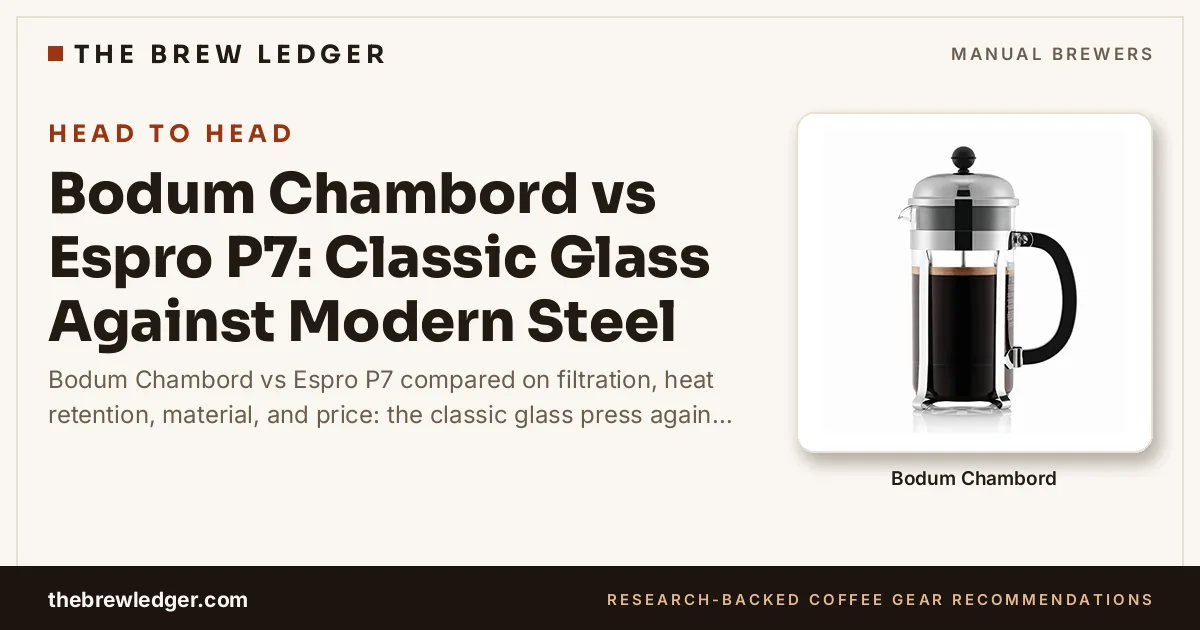
Bodum Chambord
The chrome-and-glass French press design that has defined the category since the 1950s.
- Design: Iconic French press, dating to the 1950s
- Beaker: Borosilicate glass
Sources: Bodum official product specifications, Major retailer product listings, Published coffee gear reviews
Check current price
Espro P7
The double-filtered, vacuum-insulated press that brews the cleanest French press cup.
- Capacity: 32 oz (1 liter)
- Filtration: Patented double micro-filter
Sources: Espro official product specifications, Major retailer product listings, Published coffee gear reviews
Check current priceFiltration: single mesh against double micro-filter
The Chambord uses the classic 3-part stainless steel filter: a spiral plate, a mesh screen, and a cross plate. It brews a full-bodied cup and leaves fine sediment in the last sip, which many drinkers accept as French press character. The P7 uses a patented double micro-filter: two fine screens that remove far more sediment, producing a visibly cleaner cup. This is the largest taste difference between the two presses, and it favors the P7 for anyone who dislikes grit.
Heat retention: glass against vacuum steel
The Chambord's borosilicate glass beaker cools quickly: the coffee is ideal for about 20 minutes, then it dulls. The P7's double-wall vacuum-insulated stainless steel body keeps coffee hot for over an hour and stops extraction after plunging, so the second cup tastes like the first. For slow mornings, the P7's insulation is the deciding feature; for fast single rounds, it hardly matters.
Material and durability
The Chambord is chrome and glass: beautiful on the counter, breakable in a busy kitchen, with replacement beakers sold in every size. The P7 is all steel: no glass to break, no plastic to stain, built to outlive glass rivals by years. The Chambord's fragility is a repair, not a disaster, but the P7's durability is the reason to buy steel in the first place.
Sizes and price position
The Chambord comes in 12, 17, 34, and 51 oz, so it scales from solo to entertaining. The P7 comes in 32 oz only, which suits most households but forces a second brew for guests. The Chambord costs far less than the P7, which is the fair price of the double filter and the vacuum insulation. Buy size range and looks for less, or filtration and heat for more.
Which should you buy?
Choose the Bodum Chambord if…
- You want the classic chrome-and-glass French press look on your counter.
- You need 12 oz for solo brewing or 51 oz for entertaining, not just 32 oz.
- You accept a little sediment as part of French press character.
- The budget is tight and the press must cost as little as possible.
Choose the Espro P7 if…
- Sediment in the last sip is the complaint that started your search.
- Your household drinks slowly and the second cup must stay hot.
- The press will travel, camp, or share a house with children.
- You will pay more for the cleanest cup and the toughest body.
What to expect day to day
Bodum Chambord
Our notes on living with the Bodum Chambord, drawn from its documented strengths and limitations. These are editorial expectations, not owner reviews or survey results.
Where it makes life easier
- The borosilicate glass beaker resists thermal shock without affecting flavor
- The three-part stainless steel filter assembly is simple and fully replaceable
- The four sizes from 12 to 51 oz cover everything from solo brewing to entertaining
What to plan around
- The glass beaker can break if knocked, though replacements are sold
- Fine sediment from the metal filter leaves the last sip silty
- The glass loses heat fast, so coffee cools quickly without a cozy
Espro P7
Our notes on living with the Espro P7, drawn from its documented strengths and limitations. These are editorial expectations, not owner reviews or survey results.
Where it makes life easier
- Twin micro-filter baskets pour a noticeably cleaner cup than a standard single screen
- The vacuum-insulated steel body keeps a morning pot hot for over an hour instead of minutes
- The filter halts brewing after the plunge, so the last cup poured tastes like the first
What to plan around
- The filtration upgrade costs several times the price of a basic glass press
- The steel body adds real heft compared with glass presses of similar size
- Opaque steel walls take away the visual check on the steep
Questions, answered
Which one brews better coffee?
The P7, on cleanliness: its double micro-filter removes far more sediment, so the last sip tastes like the first. The Chambord brews the same strength and body, with more grit. If you strain your press coffee or do not mind sediment, the Chambord's cup is equally good.
Is the P7 worth twice the price of a Chambord?
For the filter and the insulation, yes: those two features change the cup and the morning in ways the frame cannot. For looks and size range, no: the Chambord is the prettier press with more sizes. The honest answer is about your complaints: if you have none, buy the Chambord.
Can the Chambord's beaker be replaced if it breaks?
Yes: Bodum sells replacement beakers in every Chambord size, and swapping one takes a minute. The P7 has no beaker to break, which is the durability argument for steel, but a broken Chambord is a repair, not a replacement.
Which press is better for a first French press?
The Chambord, unless breakage is a real risk: it is cheaper, it teaches the method, and its looks make the habit pleasant. The P7 is the better second press, bought once you know you love French press coffee and want the cleanest, hottest version of it.