Review
Bialetti Brikka Review: Crema From a Stovetop Pot
In-depth Bialetti Brikka review: the only moka pot with a pressure valve that builds crema, on the espresso-like cup, the sizes, and the stovetop rules.
- Specs from manufacturer listings
- No paid placements
- Reader-supported

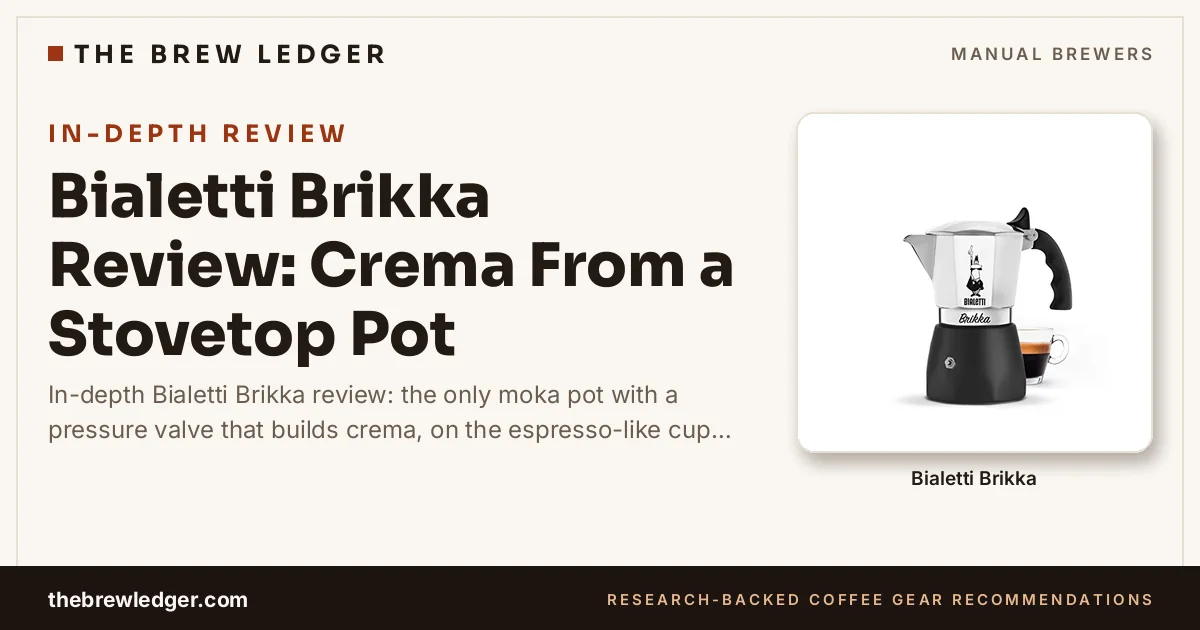
The only moka pot with a pressure valve that builds crema, the closest stovetop brewing gets to espresso.
- Material: Aluminum with silicone pressure valve
- Sizes: 2 and 4 cup
- 4-cup brew volume: Approx. 5.7 oz (170 ml)
Our verdict
The Brikka is the moka pot for drinkers who want crema without an espresso machine: a silicone pressure valve in the upper chamber holds back the brew until pressure builds, producing a crema layer no other stovetop pot here manages, and delivering the richest, most espresso-like cup of any moka pot in the range. It comes in compact 2-cup and 4-cup sizes that suit solo drinkers and couples, and cleaning the three chambers works just like the classic Moka Express. Its limits are the aluminum body, which is not induction compatible, only two sizes, and a valve that needs periodic descaling to keep the crema performance consistent. For a drinker who wants a crema-topped cup from a stovetop pot, it is the only honest pick. See how it compares in our best moka pots ranking.
Who it is for
Drinkers who want a crema-topped cup from a stovetop pot without an espresso machine.
What we like
- Silicone pressure valve holds back the brew until pressure builds, producing a crema layer
- Delivers the richest, most espresso-like cup of any moka pot here
- Compact 2-cup and 4-cup sizes suit solo drinkers and couples
- Same simple three-chamber cleaning as the classic Moka Express
What to watch out for
- Standard aluminum body is not induction compatible; the separate Brikka Induction 4-cup version is
- Only two sizes available, 2-cup and 4-cup
- Valve needs periodic descaling to keep the crema performance consistent
- Current listings ship the redesigned New Brikka with a silicone valve, not the original steel-weight valve, so older reviews describing a steel weight no longer match the pot you buy
The crema valve, explained
The Brikka's argument is one component: a silicone pressure valve in the upper chamber that holds the brew back until pressure builds, then releases it into the cup with a crema-like layer on top. No other moka pot here has it, and the difference shows in the cup: the richest, most espresso-like coffee a stovetop pot produces, with a foam cap that a standard moka pot never manages. The valve is a silicone-and-metal assembly that needs periodic descaling to keep the crema performance consistent, which is the maintenance cost of the feature. Without the valve, the Brikka would be a standard aluminum pot; with it, it is the closest stovetop brewing gets to espresso.
Sizes and the 2-cup problem
Only two sizes exist, 2-cup and 4-cup, and that narrow range is the Brikka's real limit. The 4-cup brews about 5.7 oz, which suits a solo drinker or a couple, but a household that brews for four needs two rounds or a bigger pot. The Moka Express and Venus come in sizes up to 10 and 12 cups, so the Brikka is the pot to buy when the household is small and the crema matters more than the volume. Buy for the usual batch, not the largest possible one, since a moka pot brews best near-full.
Stovetop rules: gas, electric, never induction
The aluminum body works on gas, electric coil, and radiant cooktops, but not induction, like the Moka Express. Induction households should buy the Bialetti Venus, which is stainless steel and works on every cooktop including induction, and gives up the crema valve for the privilege. The Brikka's aluminum heats quickly and evenly on a gas flame, which is its natural home, and the heat-resistant handle and lid knob stay comfortable during brewing. Check the cooktop before buying the pot, not after.
Cleaning and the valve
Cleaning the three chambers works just like the classic Moka Express: rinse, dry, and never use soap on the aluminum, which strips the seasoning that protects the flavor. The valve adds one step: periodic descaling keeps it moving freely, and a stuck valve is the usual cause when the crema disappears. Rinse the valve assembly after each brew and descale it on the same schedule as the pot, and the crema stays consistent. The Brikka asks slightly more maintenance than a plain pot, and pays for it in the cup.
Size, materials, and filters
- Material
- Aluminum with silicone pressure valve
- Sizes
- 2 and 4 cup
- 4-cup brew volume
- Approx. 5.7 oz (170 ml)
- Stovetop compatibility
- Gas, electric coil, radiant; not induction
- Signature feature
- Silicone crema valve in the upper chamber
Sources: Bialetti official product specifications, Major retailer product listings, Published coffee gear reviews
What to expect day to day
Our notes on living with the Bialetti Brikka, drawn from its documented strengths and limitations. These are editorial expectations, not owner reviews or survey results.
Where it makes life easier
- The silicone pressure valve holds the brew back until pressure builds, leaving a crema-like layer on top
- Of the stovetop pots here, it gets closest to an espresso-style cup
- Cleaning the three chambers works just like the classic Moka Express
What to plan around
- The standard aluminum body rules out induction cooktops (the separate Brikka Induction 4-cup works on induction)
- It comes in just 2-cup and 4-cup sizes
- The valve needs periodic descaling to keep the crema performance consistent
Also consider

Bialetti Moka Express
The 1933 original that defined stovetop coffee, still the benchmark everything else is judged against.
- Material: Cast aluminum
- Sizes: 1, 2, 3, 4, 6, 9, 12, and 18 cup
Sources: Bialetti official product specifications, Major retailer product listings, Published coffee gear reviews
Check current price
Bialetti Venus
Bialetti's stainless steel answer for induction cooktops, in the classic moka silhouette.
- Material: 18/10 stainless steel
- Sizes: 2, 4, 6, and 10 cup
Sources: Bialetti official product specifications, Major retailer product listings, Published coffee gear reviews
Check current priceQuestions, answered
Does the Brikka really make crema?
Yes, a crema-like layer: the silicone valve holds the brew back until pressure builds, then releases it with a foam cap that no standard moka pot produces. It is not espresso crema, since a moka pot brews at lower pressure than an espresso machine, but it is the closest a stovetop pot gets, and the difference is visible in the cup. Keep the valve descaled, or the crema fades first.
Is the Brikka better than the Moka Express?
For the cup, yes: the valve gives a richer, more espresso-like result with a crema layer the Express never manages. For price and sizes, no: the Express costs less and comes in sizes up to 12 cups, while the Brikka stops at 4 cups. Buy the Brikka when crema matters and the household is small; buy the Express when volume or budget matters more.
Can I use the Brikka on induction?
Not the standard Brikka: the aluminum body is not induction compatible, like the Moka Express. Bialetti also sells a Brikka Induction in 4-cup size with a two-layer boiler that works on induction, so induction households can still get the crema valve. The Bialetti Venus is the steel alternative, in sizes from 2 to 10 cups, but it gives up the crema valve.
Why did my Brikka stop making crema?
Almost certainly the valve: it needs periodic descaling to keep moving freely, and a stuck or scaled valve releases the brew too early, so no crema forms. Descale the valve assembly, rinse it after each brew, and check that the grind is fine enough for moka. If the valve moves freely and the crema still does not form, the coffee is stale or the grind is too coarse.