Head to head
Hario Skerton Pro vs Porlex Mini: Batch Grinder or Travel Grinder?
Hario Skerton Pro vs Porlex Mini: 100g capacity against 20g, countertop plastic against travel stainless, and which manual grinder fits your brewing.
Quick verdict
Our recommendation
Buy the Hario Skerton Pro if you grind at home for French press or cold brew: its 100g hopper swallows big batch doses in a single grind. Buy the Porlex Mini if the grinder travels: its stainless body and detachable handle pack inside an AeroPress. The Skerton is the batch grinder; the Porlex is the travel grinder. Read the best manual coffee grinders ranking before deciding.
Skerton Pro vs Mini: the spec sheet
| Product | Burr set | Capacity | Body | Adjustment | Origin | Cleaning |
|---|---|---|---|---|---|---|
| Hario Skerton Pro | Ceramic conical | 100g | BPA-free plastic with silicone base | Stepless | - | Hand wash recommended |
| Porlex Mini | Ceramic conical | 20g | Stainless steel | - | Made in Japan | - |
Swipe sideways to compare all columns
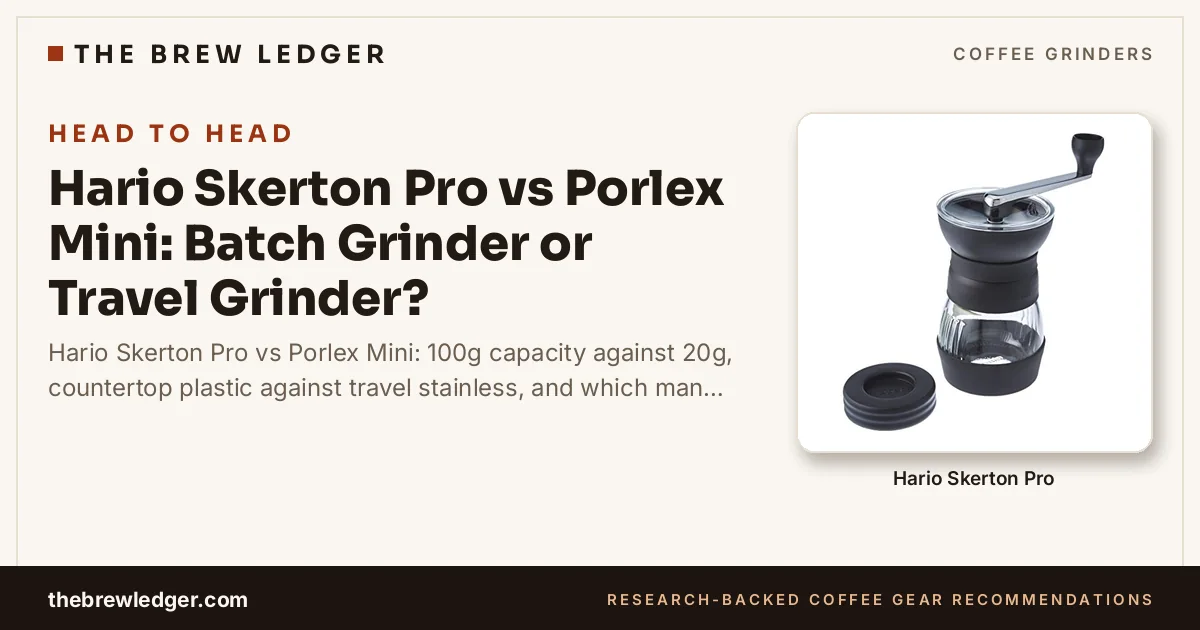
The two contenders

Hario Skerton Pro
A 100g-capacity ceramic-burr workhorse for coarse brewing on a budget.
- Burr set: Ceramic conical
- Capacity: 100g
Sources: Hario official product specifications, Major retailer product listings, Published coffee gear reviews
Check current price
Porlex Mini
A stainless, made-in-Japan compact grinder that lives inside an AeroPress.
- Burr set: Ceramic conical
- Body: Stainless steel
Sources: Porlex official product specifications, Major retailer product listings, Published coffee gear reviews
Check current priceCapacity: 100g against 20g
The Skerton's 100g hopper takes big batch doses in one grind, which suits French press and cold brew households grinding for several cups. The Porlex's 20g chamber matches single servings with no wasted grounds, but needs refills for anything beyond a single brew. Capacity alone decides this comparison for most buyers: batch households need the Skerton, solo brewers can live with the Porlex.
Body and travel: plastic countertop against stainless packing
The Skerton is a BPA-free plastic body with a silicone base that grips the counter during grinding, built to stay put in a kitchen. The Porlex is a stainless steel body, made in Japan with tight manufacturing tolerances, that shrugs off travel abuse, and its handle detaches for compact packing inside an AeroPress. One is built to stay home; the other is built to leave it.
Adjustment: stepless against click-nut
The Skerton's stepless adjustment covers the full coarse range smoothly, which suits French press and cold brew drinkers who live at the coarse end. The Porlex's click-nut adjustment is less precise than premium dials, but its range covers the single-serving brews it is built for. Neither grinder is the right tool for fine espresso work: the Skerton's documented burr-shaft wobble hurts consistency at finer settings, and the Porlex's 20g capacity limits espresso dosing anyway.
Grind speed and feel
Both use ceramic conical burrs, which never rust and hold their edge for years, but both grind more slowly than steel-burr rivals. The Skerton's larger burr chamber and countertop stance make big coarse doses less tiring; the Porlex's small chamber means fewer turns per dose but more refills. The plastic Skerton body feels less premium than the Porlex's steel, while the Porlex's steel body feels like the more durable tool in the hand.
Which should you buy?
Choose the Hario Skerton Pro if…
- You grind large coarse doses for French press or cold brew
- You want a countertop grinder that stays in one kitchen
- You prefer stepless adjustment across the coarse range
Choose the Porlex Mini if…
- You travel with a grinder, especially with an AeroPress
- You grind single servings and want no wasted grounds
- You want a stainless body that survives bags and counters
What to expect day to day
Hario Skerton Pro
Our notes on living with the Hario Skerton Pro, drawn from its documented strengths and limitations. These are editorial expectations, not owner reviews or survey results.
Where it makes life easier
- The 100g hopper takes big batch doses in one grind
- Ceramic burrs never rust and hold an edge for years
- The silicone base grips the counter and keeps the grinder steady while cranking
What to plan around
- Burr-shaft wobble hurts consistency at finer settings
- It grinds more slowly than steel-burr rivals
- The plastic body feels less premium than metal grinders
Porlex Mini
Our notes on living with the Porlex Mini, drawn from its documented strengths and limitations. These are editorial expectations, not owner reviews or survey results.
Where it makes life easier
- The stainless body handles the abuse of regular travel
- Japanese manufacturing tolerances are tight for a grinder this size
- The 20g chamber matches single servings with no wasted grounds, and the handle detaches for packing
What to plan around
- The ceramic burrs are slower going than steel alternatives
- The 20g capacity means refills for anything beyond a single brew
- The click-nut adjustment is less precise than premium dials
Questions, answered
Which grinds better for French press?
The Skerton, on capacity alone: its 100g hopper and stepless coarse range suit press doses, and its own record names French press and cold brew drinkers as its audience. The Porlex can grind for a press, but 20g at a time means refills for a full pot, which gets old fast.
Can the Porlex Mini really fit inside an AeroPress?
Yes: the handle detaches for compact packing inside an AeroPress, which is the Porlex's signature travel trick. The Skerton cannot pack this way and is a countertop grinder by design. Travelers choosing between the two should weight this packing difference above all else.
Which is better for pour-over?
Neither is ideal: the Skerton's burr-shaft wobble shows at finer settings, and pour-over sits finer than the coarse range both grinders favor. For pour-over grinding, see the best coffee grinder for pour-over, where electric burr grinders hold a medium setting more consistently.
Do ceramic burrs wear out?
Not quickly: ceramic burrs never rust and hold their edge for years, which both grinders share as an advantage. The wear point is elsewhere, in adjustment mechanisms and bodies, where the Porlex's steel body outlasts the Skerton's plastic. Burr material is not the deciding factor between these two.