Head to head
Hario V60 vs Kalita Wave
Hario V60 vs Kalita Wave: cone control against flat-bottom forgiveness, compared on shape, drawdown, filters, and who each dripper rewards.
Quick verdict
Our recommendation
Buy the Hario V60 if you pour carefully and want the highest clarity ceiling: its cone, spiral ribs, and single large hole give full control of flow rate. Buy the Kalita Wave if you want good cups without perfect technique: its flat bottom and three small holes even out extraction for inconsistent pourers. Read the best pour-over coffee makers ranking before deciding.
V60 Ceramic Dripper 02 vs Wave 185 Stainless Dripper: the spec sheet
| Product | Dripper shape | Size | Material | Filters | Drip hole | Drip holes |
|---|---|---|---|---|---|---|
| Hario V60 Ceramic Dripper 02 | Cone with spiral ribs | 02 (1 to 4 cups) | Ceramic (Arita porcelain) | Hario V60 02 paper filters | Single large hole | - |
| Kalita Wave 185 Stainless Dripper | Flat bottom | 185 (1 to 4 cups) | Stainless steel | Kalita Wave 185 paper filters | - | Three small holes |
Swipe sideways to compare all columns
The two contenders

Hario V60 Ceramic Dripper 02
The cone dripper that defined pour over: fast drawdown, total control.
- Dripper shape: Cone with spiral ribs
- Drip hole: Single large hole
Sources: Hario official product specifications, Major retailer product listings, Published coffee gear reviews
Check current price
Kalita Wave 185 Stainless Dripper
The forgiving flat-bottom: three-hole drawdown that resists channeling.
- Dripper shape: Flat bottom
- Drip holes: Three small holes
Sources: Kalita official product specifications, Major retailer product listings, Published coffee gear reviews
Check current priceShape: cone against flat bottom
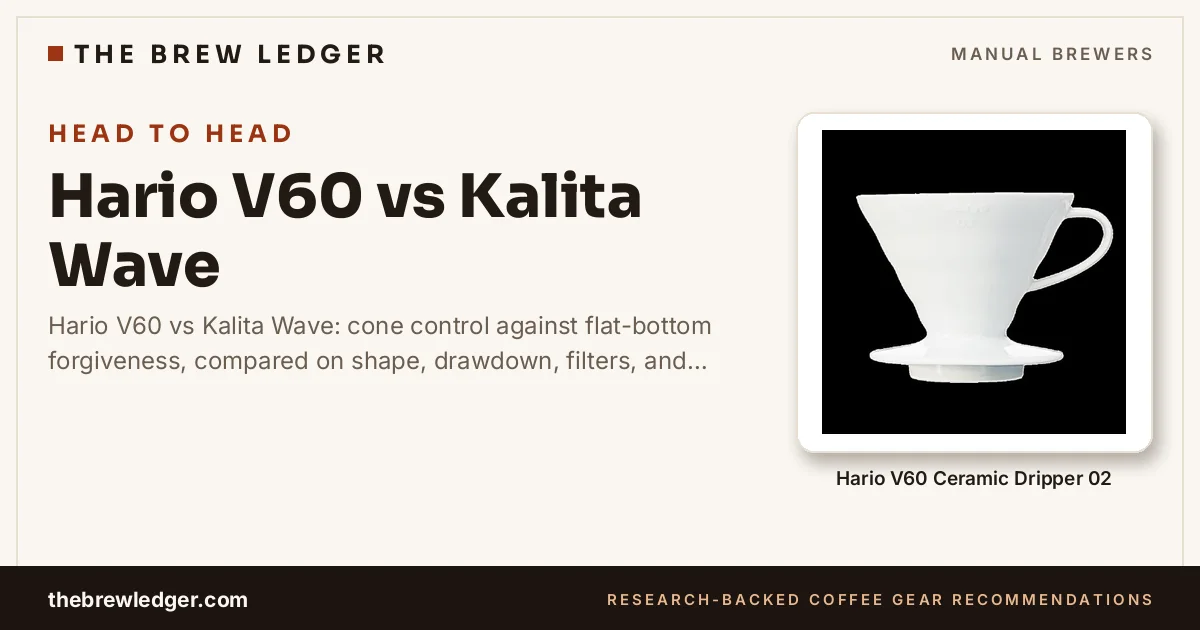
The V60 is a cone with spiral ribs and a single large drip hole, so water flows through a deepening bed and the pourer controls the rate directly. The Wave is a flat-bottom dripper with three small holes, so water spreads across a shallow, even bed and drains through three points instead of one. Cone shape rewards control; flat-bottom shape forgives its absence. That single geometric difference drives almost everything else in this comparison.
Control against forgiveness
The V60 punishes sloppy pours with uneven extraction, which is why it needs a gooseneck kettle for real control and practice to brew its best cup. The Wave is far more forgiving of imperfect pouring than cone drippers, and its own record names beginners and inconsistent pourers as its audience. A skilled pourer extracts more clarity from the V60; an inconsistent pourer extracts a better average cup from the Wave.
Material and durability: ceramic against stainless steel
The V60 here is ceramic Arita porcelain, which retains heat well but can chip or crack if knocked against hard surfaces. The Wave here is stainless steel, nearly indestructible in a shared kitchen, but it does not carry the same heat-retention story. A careful solo brewer keeps ceramic safe for years; a busy shared kitchen breaks ceramic sooner or later, and steel survives it.
Filters and grind sensitivity
Both brew 1 to 4 cups in the sizes here, V60 size 02 and Wave size 185, but their filters differ in cost and availability: Wave 185 filters are pricier and less widely stocked than V60 filters. Grind sensitivity differs too: the Wave flat bed can stall with very fine grinds, while the V60 large hole lets a fine grind draw down fast and unevenly if the pour is careless. Medium grind suits both, but for different reasons.
Which should you buy?
Choose the Hario V60 Ceramic Dripper 02 if…
- You pour carefully and want maximum control over drawdown
- You already own a gooseneck kettle or will buy one
- You chase clarity and nuance over consistency
Choose the Kalita Wave 185 Stainless Dripper if…
- You are learning pour-over or pour inconsistently
- You want a dripper that survives a shared kitchen
- You prefer a forgiving daily cup over a demanding best cup
What to expect day to day
Hario V60 Ceramic Dripper 02
Our notes on living with the Hario V60 Ceramic Dripper 02, drawn from its documented strengths and limitations. These are editorial expectations, not owner reviews or survey results.
Where it makes life easier
- The cone shape with spiral ribs promotes fast, even drawdown
- The large single drip hole gives you full control of flow rate
- The ceramic body retains heat well, and the 02 size brews 1 to 4 cups
What to plan around
- It is unforgiving of poor pouring technique, especially when you are starting out
- Real control needs a gooseneck kettle, which adds to setup cost
- The ceramic can chip or crack if knocked against hard surfaces
Kalita Wave 185 Stainless Dripper
Our notes on living with the Kalita Wave 185 Stainless Dripper, drawn from its documented strengths and limitations. These are editorial expectations, not owner reviews or survey results.
Where it makes life easier
- The flat-bottom bed with three small holes evens out extraction
- It is far more forgiving of imperfect pouring than cone drippers
- The stainless steel body is nearly indestructible, and the 185 size brews 1 to 4 cups
What to plan around
- At its best it gives less clarity and nuance than a well-poured V60
- Wave 185 filters cost more and are less widely stocked than V60 filters
- The flat bed can stall with very fine grinds
Questions, answered
Which makes better coffee, V60 or Kalita Wave?
At its best, the V60, on clarity and nuance, because its cone and large hole allow precise control. On an average morning, the Wave, because its flat bottom forgives an imperfect pour that would unevenly extract a V60 brew. The honest answer depends on the pourer, not the dripper alone.
Do I need a gooseneck kettle for the Kalita Wave?
Not as urgently as for the V60. The Wave three small holes slow the flow for you, so a regular kettle produces a decent cup, while the V60 large hole responds directly to pour rate and needs a gooseneck for real control. A gooseneck still helps the Wave, but it is not a requirement.
Which filters cost more over a year?
Kalita Wave 185 filters, which are pricier and less widely stocked than V60 filters. Daily brewers should count that ongoing cost: a dripper that looks equally priced can cost noticeably more across a year of filters. The Melitta #2 filters, available in any grocery store, are the cheapest alternative of all.
Can a beginner start on the V60?
Yes, but expect uneven cups while learning, because the V60 punishes sloppy pours. Beginners who want good coffee from the first week should start on the Wave or the Melitta and move to the V60 when technique, not the tool, becomes the limit. Starting on the V60 is a choice to learn by tasting mistakes.