How to
How to Choose a Coffee Maker
How to choose a coffee maker: count the drinkers, pick the drink, weigh effort against control, and buy for the routine, not the showroom.
The short answer
Count the drinkers, name the drink, and be honest about effort: a pot household buys the OXO Brew 9-Cup, a solo fast morning buys the Keurig K-Express, and a milk-drink household willing to learn buys the Gaggia Classic Pro. Work the five steps below before comparing prices, and read the best coffee maker for the ranked shortlist.
Step by step
Count the drinkers and the cups
Write down how many people drink, how many cups each drinks, and whether those cups happen together or scattered through the day. A pot serves together-drinkers cheaply; scattered solo cups favor single-serve; a household split between the two needs a dual machine. This one count eliminates most of the catalog before any feature comparison begins.
Name the drink, not the machine
Black coffee from a pot, a flat white, an iced coffee, and a single careful pour over are different drinks that need different machines. If milk drinks dominate, you need steam or a frother, and a drip machine will disappoint no matter how good its reviews are. If iced coffee dominates, a cold brew pitcher beats every hot brewer with ice in it.
Weigh effort against control
Pod machines ask almost nothing and give almost no control. Drip machines ask for grounds and a filter and give a consistent pot. Pour over asks for technique and gives total control. Espresso asks for a grinder, practice, and patience and gives cafe drinks. Pick the effort level you will actually sustain on a tired Tuesday, not the one that sounds good on a Saturday.
Measure the counter and the budget honestly
Measure the space, including clearance to fill the tank and open the lid, and budget for the running costs, not just the machine: pods cost far more per cup than grounds, and espresso needs a grinder that can cost as much as the machine. A machine that does not fit, or that you resent feeding, will sit unused whatever its reviews said.
Test the routine for a week on paper
Before buying, walk a normal week through the machine you are considering: who fills it, who cleans it, where the grounds go, and what happens on the busiest morning. If any step depends on a habit nobody in the house has, pick the simpler machine. The best coffee maker is the one that still gets used in month six.
Gear for each routine

For pot-drinking households
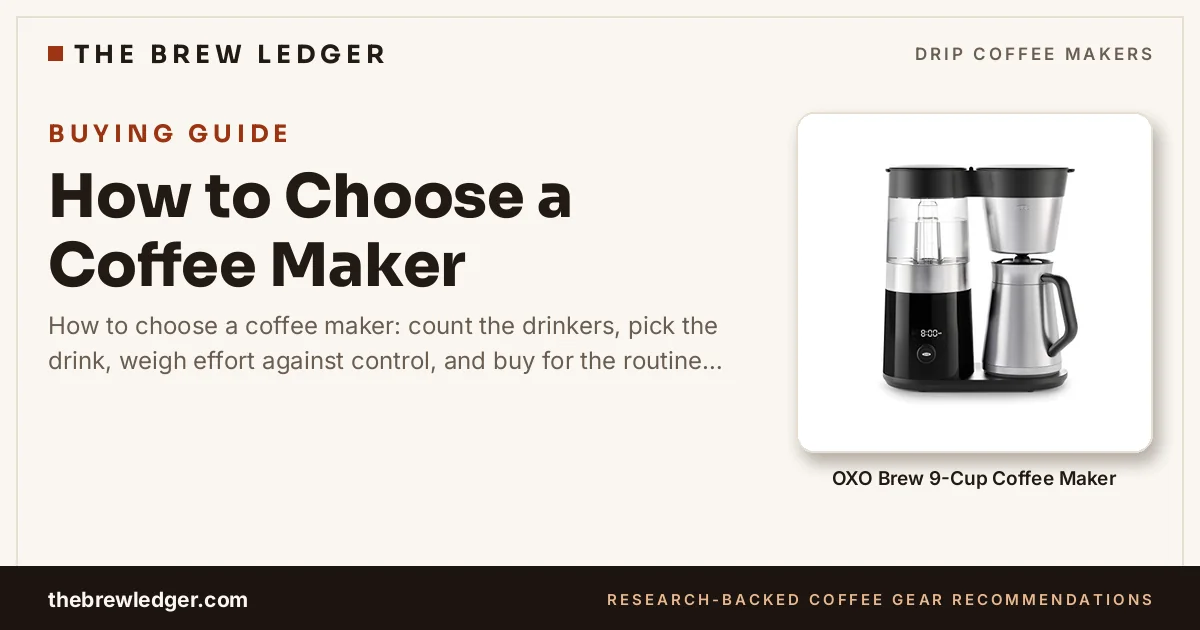
OXO Brew 9-Cup Coffee Maker
- Capacity: 9 cups
- Certification: SCA Golden Cup Certified at launch (not on current list)
- Carafe: Double-wall vacuum-insulated thermal
Golden Cup certified brewing at launch, a thermal carafe, and a cup-count dial for varying batch sizes. The default answer when the routine is a morning pot for two or more people.

For solo, fast mornings
Keurig K-Express
- Brew method: K-Cup pods (My K-Cup reusable filter compatible)
- Cup sizes: 8, 10, 12 oz
- Reservoir: 42 oz removable
A genuine Keurig with strong brew and three cup sizes for little more than the smallest model. The default answer when the routine is one cup, quickly, before leaving the house.

For learning espresso
Gaggia Classic Pro RI9380
- Pump: 15-bar ULKA, factory set to 9 bar (E24)
- Portafilter: 58mm stainless steel
- Valve: 3-way solenoid
A commercial group and a huge owner community for households whose routine includes milk drinks and a willingness to practice. The default answer when the drink, not the speed, is the point.
Questions, answered
How much should I spend on a coffee maker?
Enough to reach certified drip brewing for a pot household, or a proven pod or espresso platform for those routines. Beyond that tier, spend moves toward control and convenience rather than better black coffee, so spend on the routine you actually have.
Is a grinder more important than the machine?
For espresso and pour over, yes: a weak grinder wastes a good machine. For drip and pod brewing, no: the machine and the beans matter more. Budget the grinder into an espresso purchase from the start rather than discovering it afterwards.
What is the biggest beginner mistake?
Buying for an imagined routine: an espresso machine for a household that drinks one rushed cup, or a 14-cup pot for a solo drinker. Match the machine to the week you actually live, using the steps above, and the purchase mostly makes itself.
Should I buy one machine that does everything?
Only a split household truly needs one, and the FlexBrew pick in the best coffee maker covers that case. Combination machines usually do each job worse than a dedicated machine, and they add parts to clean. One great routine beats three mediocre ones.