How to
How to Choose a Cold Brew Maker
How to choose a cold brew maker: start with batch size, let the filter decide sediment, and weigh fridge space against cleanup.
The short answer
Choose by batch and filter: the OXO Brew gives the cleanest small-batch concentrate with no filter purchases, the Takeya is the simplest fridge-door pitcher, and the Toddy brews large, low-sediment batches for daily drinkers. Work the five steps below, then read the best cold brew coffee makers and how to brew cold brew before buying.
Choose a cold brew maker in five steps
Start with batch size, not features
Count how much cold brew the household drinks before the next batch is ready. One or two daily drinkers suit the OXO's compact batch or the Takeya's 1-quart size. A household drinking cold brew daily needs the Toddy's large batch or the Takeya's 2-quart size. Brewing twice a week because the maker is too small is the fastest way to abandon cold brew entirely.
Let the filter decide the sediment question
Mesh filters are convenient and reusable, but fine mesh passes some sediment into the cup, as both the Takeya and the OXO's rivals show. Ultra-fine stainless mesh, like the OXO's, cuts sediment further with no ongoing purchases. Felt filters, like the Toddy's, give the cleanest, heaviest-bodied concentrate at the cost of rinsing and air-drying after each use. If gritty cups bother you, the filter matters more than the vessel.
Decide concentrate or ready to drink
Most immersion makers brew a concentrate you dilute to taste, which is why the OXO's measurement-marked carafe helps: it makes dilution repeatable. Ready-to-drink pitchers skip dilution but take more fridge space per cup of coffee. Households that drink cold brew black and strong suit concentrate; households that drink it milky and mild may prefer a ready-to-drink pitcher they pour straight from.
Measure the fridge space honestly
Cold brew lives in the fridge for its whole steep and storage life, so height and footprint are real constraints. The OXO's tall profile takes meaningful shelf height, the Toddy's two-vessel setup takes counter and fridge space, and the Takeya's pitcher shape is the most fridge-door friendly. Measure the shelf before buying, not after the first steep.
Weigh cleanup against batch frequency
A maker brewed weekly must be easy to clean weekly. Twist-out mesh filters rinse in seconds, auto-drain designs like the OXO's avoid lifting a heavy filter, and felt filters demand rinsing and drying every time. Plastic brew chambers, like the OXO's, hold coffee oils and need regular washing. The best maker is the one whose cleanup you will actually do on the schedule its batches require.
Three makers for three households

For the cleanest concentrate
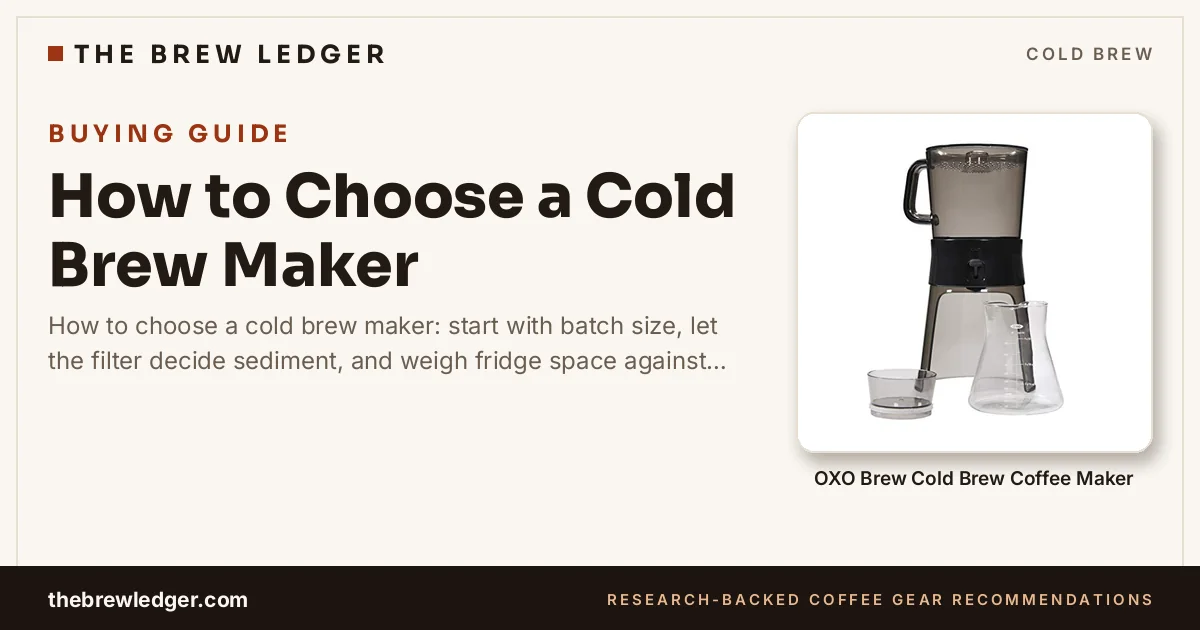
OXO Brew Cold Brew Coffee Maker
- Brew method: Immersion
- Filter: Reusable ultra-fine stainless steel mesh
- Distribution: Rainmaker shower-head lid
The most engineered immersion brewer here: a rainmaker shower-head lid for even saturation, a reusable ultra-fine stainless steel mesh filter with no ongoing filter purchases, auto-drain separation of grounds from concentrate, and a glass carafe with measurement markings for diluting to taste. The batch is compact, suiting one or two daily drinkers rather than a household.

For fridge-door simplicity
Takeya Cold Brew Coffee Maker
- Brew method: Immersion
- Material: BPA-free Tritan plastic
- Filter: Reusable fine-mesh filter
A shatterproof BPA-free Tritan pitcher with a reusable fine-mesh filter that twists in and lifts out, in 1-quart and 2-quart sizes, with an airtight lid that keeps brewed coffee fresh up to 2 weeks refrigerated. It lives in the fridge door and asks almost nothing of you. The fine mesh passes some sediment, and there are no concentrate markings for dilution ratios.

For big, low-sediment batches
Toddy Cold Brew System
- Brew method: Immersion
- Filter: Reusable felt filters (paper bags optional)
- Steep time: 12 to 24 hours
The original since 1964, built around reusable felt filters that produce a noticeably sediment-free, heavy-bodied concentrate in large batches covering several days from one steep. Paper filter bags are also available for near-zero cleanup. Felt filters need rinsing and air-drying after each use to avoid mildew, and the two-vessel setup takes real counter and fridge space.
Questions, answered
How long does cold brew take to steep?
Twelve to 24 hours for immersion makers like all three picks here, with the Hario Mizudashi as the shorter exception at 8 to 12 hours. Longer steeps extract more body and sweetness up to a point, then turn bitter and woody. Taste at 12 hours and extend only if the concentrate still tastes thin.
How do I dilute cold brew concentrate?
Start with equal parts concentrate and water or milk, then adjust to taste. The OXO's measurement-marked carafe makes this repeatable; for unmarked pitchers, mark your own ratio on the first batch and reuse it. Dilution is personal: strong concentrate suits iced lattes, lighter dilution suits black iced coffee.
How long does brewed cold brew keep?
Refrigerated and airtight, brewed cold brew keeps well for days: the Takeya's airtight lid keeps it fresh up to 2 weeks refrigerated. Flavor still fades with time, so the practical rule is to brew what the household drinks within a week and treat two weeks as the outer limit, not the target.
Why is my cold brew bitter or silty?
Bitterness usually means too fine a grind or too long a steep; silt means the filter passed fines the grinder created. Coarsen the grind first, shorten the steep second, and switch to a finer filter third. Our best coffee grinder for cold brew ranking covers the grinding side of the problem.