How to
How to Choose a Super-Automatic Espresso Machine
How to choose a super-automatic espresso machine: milk system first, then menu and profiles, grinder and capacities, cleaning, and counter space.
The short answer
Choose by milk first: the Philips 3300 LatteGo for easy one-touch milk drinks, the Gaggia Anima for straightforward espresso with manual milk, and the Jura ENA 4 for black coffee only in the smallest footprint. Work the five steps below, then read the best super-automatic espresso machines and the super-automatic buying guide before buying.
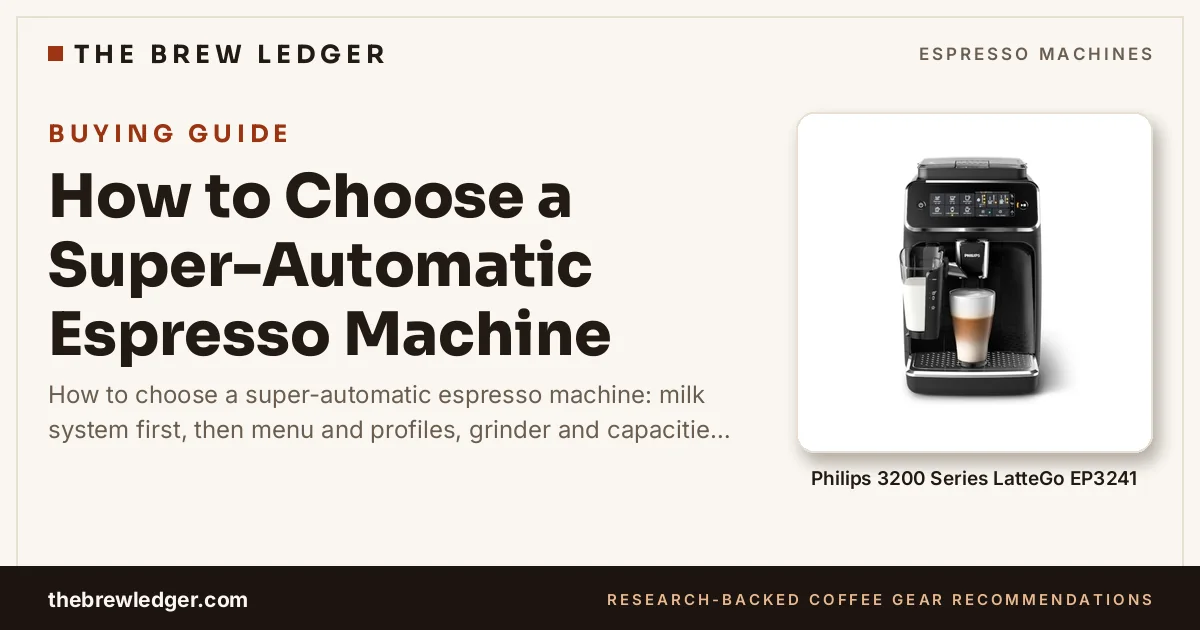
Choose a super-automatic in five steps
Milk system first, espresso engine second
Every super-automatic here runs a 15-bar pump, so espresso quality alone does not separate them. What separates them is milk: the Philips 3300 LatteGo system with 2 parts and no tubes, the Gaggia Anima Panarello wand that needs manual steaming, and the Jura ENA 4 with no milk system at all. Decide how milk drinks happen in your household before comparing anything else, because a black-coffee machine cannot be upgraded into a milk machine later.
Count the menu and the profiles honestly
Five one-touch drinks, like the Philips 3300, cover a solo or couple routine. Fifteen drinks with user profiles, like the Saeco Xelsis, cover a multi-drinker household where everyone orders differently. The Gaggia Anima short menu and the Jura ENA 4 black-coffee focus are not flaws for their buyers, but they are deal-breakers for a household that wants variety. Buy the menu you will actually drink from, not the longest menu on the shelf.
Size the grinder, tank, and hopper to the household
Tank and hopper size set refill frequency: the Philips 3300 at 1.8 L and 275 g and the Gaggia Anima at 1.8 L and 250 g suit daily household use, while the Jura ENA 4 at 1.1 L and 125 g needs frequent refilling and suits a solo drinker. Grinder adjustment matters too: the Philips ceramic grinder at 12 steps and the Gaggia ceramic burr at 5 settings give different dial-in ranges for different roasts. Match capacities to drinkers, not to the showroom.
Weigh cleaning and descaling before buying
Milk systems and brew groups need cleaning on a schedule, and that schedule is part of ownership. LatteGo with 2 dishwasher-safe parts is the lightest milk cleanup here, removable brew groups like the DeLonghi rinse under the tap, and AquaClean filters on the Philips models stretch descaling intervals to 5000 cups. More automation means more cleaning cycles, as the Xelsis record notes, so ask whether you will run the cycles the machine you buy demands.
Measure the counter and the power draw
Super-automatics are large, and the widest menus need the largest bodies: the Xelsis large footprint is the price of its depth, while the Jura ENA 4 ultra-compact footprint is the reward for its narrow focus. Power draw varies too, from the Gaggia at 1400W to the Philips 4300 at 1500W. Measure depth, height, and outlet access before ordering, since a machine that does not fit the counter will not brew well anywhere else.
Three machines for three households

For easy one-touch milk drinks
Philips 3300 Series LatteGo EP3326/90
- Pump: 15-bar
- Grinder: 100% ceramic, 12-step adjustment
- Water tank: 1.8 L
LatteGo milk with just 2 parts and no tubes, dishwasher safe, five one-touch drinks plus an iced-coffee preset, a 100 percent ceramic grinder with 12-step adjustment, a 1.8 L tank, a 275 g hopper, and AquaClean allowing up to 5000 cups without descaling make this the beginner milk-drink answer, with SilentBrew quieter grinding than the 3200 it replaces. No user profiles means multi-drinker households share settings, and milk texture is good rather than great, but cleanup simplicity is unmatched here.

For straightforward espresso without a milk menu
Gaggia Anima
- Pump: 15-bar
- Power: 1400W
- Grinder: Ceramic burr, 5 settings
Italian-built simplicity: a ceramic burr grinder that stays sharp longer than steel in home use, Optiaroma adjusting brew strength across a useful range, a 1.8 L tank and 250 g hopper, and straightforward serviceability. The base model carries a Panarello steam wand, not a one-touch milk system, and the drink menu is short next to Philips and Jura rivals, so it suits a buyer who wants espresso done well and milk as an occasional manual job.

For black coffee in the smallest footprint
Jura ENA 4
- Pump: 15-bar
- Power: 1450W
- Grinder: AromaG3 conical burr (newer units: Professional Aroma Grinder, models 15518/15519)
Jura quality in the smallest footprint the brand makes: an AromaG3 grinder and P.E.P.-style extraction in a compact chassis, with a simple interface focused on black coffee done well and Swiss build quality in the smallest package. There is no milk system at all, so cappuccino and latte drinkers must look elsewhere, and a 125 g hopper and 1.1 L tank need frequent refilling, but for a solo black-coffee drinker with minimal counter space it is the uncompromising pick.
Questions, answered
Do super-automatic machines need a separate grinder?
No. Every pick here grinds beans itself: the Philips ceramic grinder, the Gaggia ceramic burr, and the Jura AromaG3 are built in. That is the point of a super-automatic: whole beans in, finished drink out, with grind adjustment on the machine for different roasts.
Is a ceramic grinder better than steel?
For home use, ceramic stays sharp longer and runs cooler, which is the Philips and Gaggia case. Steel conical burrs, like the DeLonghi at 13 settings, offer a wider adjustment range in that model. Grinder material alone should not decide the purchase: milk system and menu matter more for most buyers.
How often will I descale a super-automatic?
It depends on the filter, not a fixed calendar. Philips AquaClean filters allow up to 5000 cups without descaling on the 3300 and 4300, which stretches the interval far beyond unfiltered machines. Follow the machine's own indicator and use filtered water to slow scale, rather than a generic schedule.
Can a super-automatic replace a manual espresso machine?
For convenience, yes; for control, no. A super-automatic automates grinding, dosing, tamping, and milk, which is why beginners and busy households love them. Manual machines give control over every variable and better milk texture in skilled hands, but demand time and practice a super-automatic deliberately removes.