Best of
The Best Espresso Machine Under $500 in 2027
Ranked for 2027: espresso machines under $500 on pump, portafilter, steam, and build, for real espresso without paying for a grinder or one-touch milk.
The short answer
Under $500, buy the Breville Bambino for the fastest honest start if you already own a grinder, the Gaggia Classic Pro if espresso might become a hobby, the DeLonghi Dedica Arte for the slimmest machine with latte-art steam, or the DeLonghi Stilosa for the cheapest way to test home espresso. See the best espresso machines and the best espresso machine under $2000 for the wider rankings.
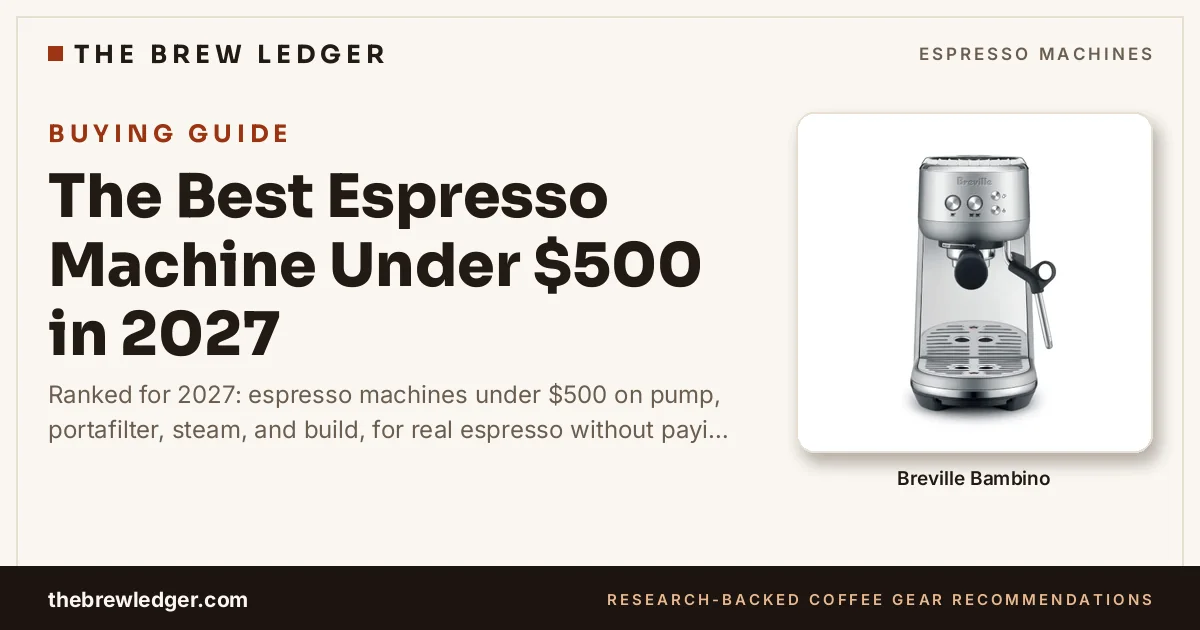
Under $500 buys real espresso, not a toy: 15-bar pumps, proper portafilters, and manual steam wands, if you skip the built-in grinder and the one-touch milk.
Espresso machines under $500 at a glance
Ranked on pump, portafilter, steam, and build
| Product | Portafilter | Pump | Water tank | Width | Heat-up |
|---|---|---|---|---|---|
| Breville Bambino | 54 mm | - | 47 oz | 7.6 in | ThermoJet, 3 seconds |
| Gaggia Classic Pro RI9380 | 58mm stainless steel | 15-bar ULKA, factory set to 9 bar (E24) | 72 oz (2.1 L) | - | - |
| DeLonghi Dedica Arte EC885 | 51 mm | 15-bar | 35 oz (1.1 L) | 5.9 in | Thermoblock, 40 seconds |
| DeLonghi Stilosa EC260BK | 2-in-1: ESE pods or ground coffee | 15-bar | - | - | - |
Swipe sideways to compare all columns

01Best starter under $500
Breville Bambino
- Width: 7.6 in
- Heat-up: ThermoJet, 3 seconds
- Milk: Manual steam wand
The Bambino is the easiest way into real espresso under $500: a ThermoJet system that heats in 3 seconds, low-pressure pre-infusion, and a 54 mm portafilter, in a 7.6-inch-wide box that fits the tightest counter. The manual steam wand textures genuine microfoam once you learn it, and the 47 oz tank covers several mornings before a refill. The trade is the missing grinder: the Bambino needs a separate burr grinder, so the true first cost is machine plus grinder, and the manual wand has less power than the Plus. For a buyer who already owns a grinder, it is the fastest honest start at this price.

02Best machine for hobbyists
Gaggia Classic Pro RI9380
- Pump: 15-bar ULKA, factory set to 9 bar (E24)
- Portafilter: 58mm stainless steel
- Valve: 3-way solenoid
The Gaggia is the machine to buy if espresso might become a hobby: a 58 mm stainless steel portafilter on a commercial group head, a 3-way solenoid valve that dries the puck and stops post-shot dripping, and a commercial steam wand for real microfoam, with a 72 oz tank that is the largest here. The trade is the single boiler: a real wait sits between brewing and steaming, there is no PID so temperature surfing is part of ownership, and it needs a good standalone grinder to show what it can do. For a buyer who will tune, repair, and keep a machine for a decade, nothing else under $500 is built like it.

03Slimmest serious machine
DeLonghi Dedica Arte EC885
- Width: 5.9 in
- Pump: 15-bar
- Heat-up: Thermoblock, 40 seconds
The Dedica Arte is the slim pick: 5.9 inches wide, the slimmest serious machine here, with a 15-bar pump, a thermoblock that heats in 40 seconds, and a My Latte Art steam wand that textures genuine microfoam. It takes ground coffee or ESE pods, with a flow stop for drink volume, and the 51 mm portafilter keeps the routine simple. DeLonghi has since replaced the original Arte with the Dedica Duo (EC890), which keeps the 5.9 in width and 51 mm portafilter and adds Cold Extraction and a touchscreen. The trade is capacity and stability: the 37 oz (1.1 L) tank needs frequent refills in multi-drink households, there is no grinder so one must be budgeted separately, and the light chassis can move on the counter during tamping. For a small kitchen that still wants latte-art steam, it is the narrowest honest answer.

04Cheapest honest entry
DeLonghi Stilosa EC260BK
- Pump: 15-bar
- Boiler: Stainless steel boiler
- Portafilter: 2-in-1: ESE pods or ground coffee
The Stilosa is the cheapest honest entry under $500: a 15-bar pump with a stainless steel boiler, a manual frother, and a 2-in-1 portafilter that takes ESE pods or ground coffee, with a two-level cup holder that fits taller mugs. It asks nothing of the buyer except a grinder and a little patience with the manual frother. The trade is refinement: it is the most basic machine here, with no temperature control worth naming and a manual frother that rewards practice rather than pressing a button. For a buyer testing whether home espresso is for them, it is the lowest-risk way to find out.
Questions, answered
Can you get real espresso for under $500?
Yes, if the budget goes to the machine and not to extras. Every pick here has a 15-bar pump and a proper portafilter: the Bambino at 54 mm, the Dedica Arte at 51 mm, and the Gaggia at the commercial 58 mm standard. What $500 does not buy is a built-in grinder or one-touch milk, so budget a separate grinder or buy a machine-and-grinder bundle with eyes open.
Do I need a separate grinder with a sub-$500 machine?
Yes for three of these four, and effectively for all of them. None of the picks has a built-in grinder, and the Gaggia in particular needs a good standalone grinder to show what it can do. The Stilosa and Dedica Arte accept ESE pods, which dodge the grinder question entirely, but pods cost more per cup than beans.
Which under-$500 machine steams milk best?
The Gaggia, with its commercial steam wand, then the Dedica Arte with its My Latte Art wand, then the Bambino with its manual wand. All three need practice; none textures milk at the press of a button. Buyers who want automatic microfoam should look at the Bambino Plus instead, which sits above this price band.
Is the Gaggia Classic Pro too demanding for a first machine?
It depends on temperament, not skill. The Gaggia rewards a buyer who enjoys tuning and does not mind temperature surfing or waiting between brewing and steaming on a single boiler. A buyer who wants coffee with no learning curve should take the Bambino, which heats in 3 seconds and asks far less.