Review
Bodum Brazil Review
In-depth Bodum Brazil review: the budget Bodum French press on brew quality, frame, sizes, and whether the plastic frame is a fair trade for the price.
- Specs from manufacturer listings
- No paid placements
- Reader-supported

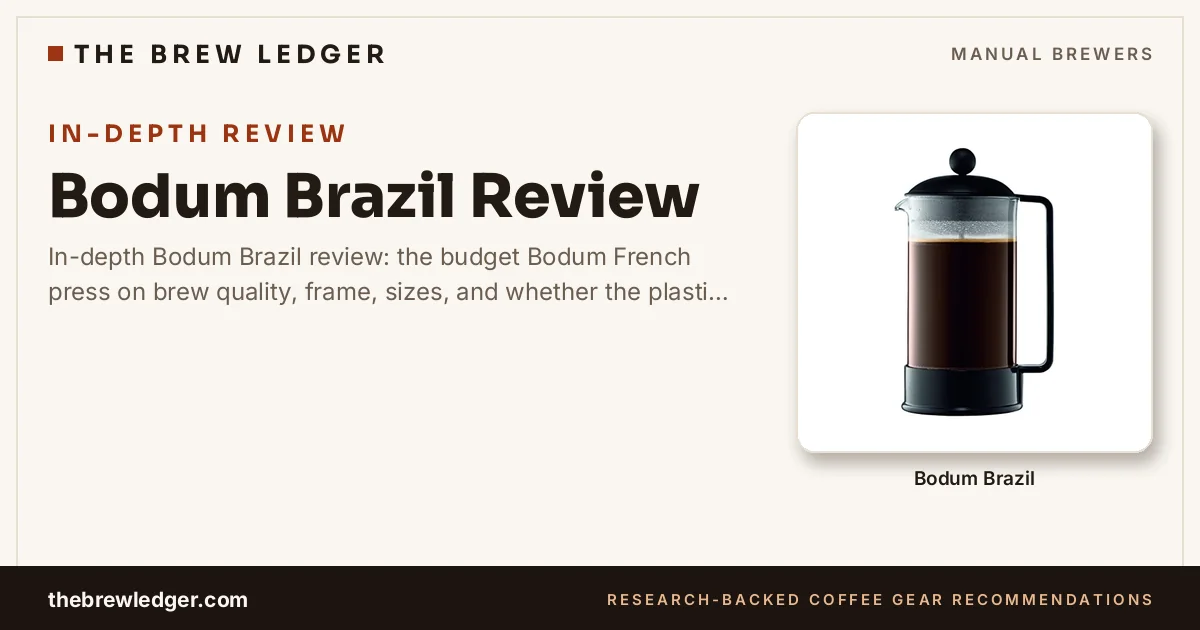
Bodum's budget press: the same glass beaker and steel filter with a plastic frame.
- Beaker: Borosilicate glass
- Frame: BPA-free plastic
- Filter: 3-part stainless steel
Our verdict
The Brazil is the honest budget Bodum: the same borosilicate glass beaker and 3-part stainless steel filter as the Chambord, in a BPA-free plastic frame, in 12, 34, and 51 oz sizes. The coffee is identical to the Chambord's, because the brewing parts are identical; the savings come entirely from the frame. Its limits are the frame itself, which looks and feels cheaper than chrome and can stain or hold odors after years of heavy use, plus the usual glass-press trade-offs of sediment and fast heat loss. For a first press or a tight budget, it is the same brew for the lowest price. See how it compares in our best French press picks and best glass French press rankings.
Who it is for
First-time French press buyers who want the real Bodum brew for the lowest price.
What we like
- Borosilicate glass beaker identical in function to the Chambord's
- Three-part stainless steel filter assembly
- BPA-free plastic frame keeps the price down and stays cool to touch
- Available in 12, 34, and 51 oz sizes
What to watch out for
- Plastic frame looks and feels cheaper than the Chambord's chrome
- Same sediment and heat-loss trade-offs as any glass press
- Plastic can stain or retain odors over years of heavy use
Design and build
The Brazil is a Chambord with the chrome swapped for BPA-free plastic: same glass beaker, same 3-part stainless filter, same plunge, different frame. The plastic frame stays cool to touch even with a full pot of hot coffee, which is a small daily comfort the chrome frame does not offer. The cost is visible: the press looks like a budget product next to stainless appliances, and plastic is the material that ages worst in a kitchen, picking up stains and lingering odors after years of daily use.
Sizes and the 34 oz standard
Three sizes span 12 to 51 oz, and the 34 oz is the household standard: about four mugs, or two large ones. The 12 oz suits a solo drinker and the 51 oz suits entertaining, but the same rule applies as with every press: brew near-full, because a press brewed half full makes thin, under-dosed coffee. The missing 17 oz size that the Chambord offers is no loss in practice, since few households brew exactly two small mugs.
Filtration and heat: the honest trade-offs
The filter is the Chambord's filter, so the cup is the Chambord's cup: full-bodied, with fine sediment in the last sip and a four-minute steep that rewards a coarse grind. Glass sheds heat fast, so the coffee is ideal for about 20 minutes and then cools; preheat the beaker with hot water to buy a few extra minutes, or accept that the Brazil, like every glass press, is a brew-and-serve tool rather than a keep-warm one.
How it stacks up
Against the Bodum Chambord (12, 17, 34, and 51 oz, same glass beaker and 3-part filter in a chrome frame), the Brazil brews an identical cup; the Chambord buys the chrome-and-glass looks and a more premium feel, while the Brazil buys the same coffee for less. Against the Espro P3 (32 oz, patented double micro-filter, borosilicate glass), the Brazil costs less but leaves more sediment in the cup and cools just as fast; choose the P3 when grit in the last sip is the complaint. Against the Espro P7 (32 oz, double micro-filter, vacuum-insulated steel), the Brazil is a different class of press entirely: cheaper, glass, and honest about it.
Size, materials, and filters
- Beaker
- Borosilicate glass
- Frame
- BPA-free plastic
- Filter
- 3-part stainless steel
- Sizes
- 12, 34, and 51 oz
- Position
- Bodum's entry-level French press
Sources: Bodum official product specifications, Major retailer product listings, Published coffee gear reviews
What to expect day to day
Our notes on living with the Bodum Brazil, drawn from its documented strengths and limitations. These are editorial expectations, not owner reviews or survey results.
Where it makes life easier
- It shares the brewing core of Bodum's pricier chrome press at an entry-level price
- The plastic frame stays comfortable to grip even with a full pot of hot coffee
- The choice of 12, 34, and 51 oz sizes covers everything from one mug to a family breakfast
What to plan around
- The plastic frame looks cheap next to stainless appliances
- The familiar glass-press trade-offs remain, with sediment in the cup and heat fading fast
- The frame can pick up stains and lingering odors after years of daily use
Also consider

Bodum Chambord
The chrome-and-glass French press design that has defined the category since the 1950s.
- Design: Iconic French press, dating to the 1950s
- Beaker: Borosilicate glass
Sources: Bodum official product specifications, Major retailer product listings, Published coffee gear reviews
Check current price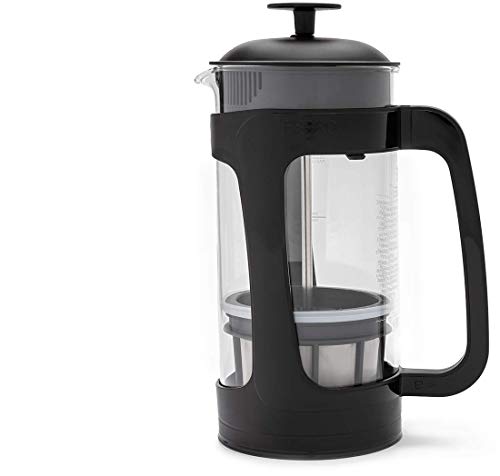
Espro P3
Espro's double micro-filter in a glass body for less than the vacuum-insulated P7.
- Capacity: 32 oz
- Filtration: Patented double micro-filter
Sources: Espro official product specifications, Major retailer product listings, Published coffee gear reviews
Check current priceQuestions, answered
Is the Brazil the same coffee as the Chambord?
Yes: the beaker and the 3-part stainless filter are functionally the same, so the extraction is the same. The difference is the frame, plastic against chrome, and the price. If the press lives in a cabinet, buy the Brazil; if it lives on the counter, the Chambord's looks may be worth the premium.
Does the plastic frame get hot or warp?
No: the BPA-free plastic frame stays cool to touch and is designed for the heat of a full pot. It can stain or retain odors over years of heavy use, which is the real aging cost, not warping. Hand washing the frame extends its clean look.
What size Brazil should I buy?
34 oz for most households: about four mugs. The 12 oz suits a solo drinker and the 51 oz suits entertaining, but a press brews best near-full, so buy for the usual batch, not the largest possible one.
Why is my Brazil coffee gritty?
The single mesh filter leaves fine sediment, which is normal for a standard press. Use a coarse grind, steep four minutes, plunge slowly, and pour everything out immediately. If grit still bothers you, the Espro P3's double micro-filter is the upgrade that fixes it.