How to
How to Pull Your First Espresso Shot in 2027: Dose, Tamp, and the 25-Second Rule
Pull your first espresso shot step by step: dose 18 grams, distribute and tamp level, time 25 to 30 seconds for 36 grams out, and read sour against bitter so the next shot is better than the last.
The short answer
Dose 18 grams into a double basket, distribute and tamp level, lock in, and start the shot. Aim for 36 grams of espresso in 25 to 30 seconds. First drops should appear in 5 to 8 seconds. Sour means too fast or too coarse; bitter means too slow or too fine. Change the grind one step and pull again.
Step by step
Start with the grinder, not the machine
The grinder decides the shot more than the machine does, because espresso needs a fine, even grind that a blade grinder cannot make and pre-ground coffee loses within days of opening. If the budget only stretches to one purchase, buy the grinder first and the machine second: a good grinder on a cheap machine pulls better shots than a great machine on a bad grinder. Pressurised baskets change the maths: the Stilosa and the Bambino ship with them, and they forgive pre-ground coffee and rough grinding by building pressure behind a small valve. Non-pressurised baskets, the Gaggia and the Barista Express with its standard baskets, punish a weak grinder and reward a good one. If you are buying the grinder as well, the best espresso grinder for beginners ranks the ones that hold a fine setting without drifting.
Dose 18 grams and weigh it
Dose 18 grams of beans into a double basket and weigh it on a scale, every time. Eighteen grams in and 36 grams out is the 1-to-2 ratio most recipes start from, and it gives a shot with enough body to taste the difference when something changes. A single basket takes 9 to 10 grams, but the double is the easier basket to learn on: the puck is thicker, the flow is steadier, and the margin for error is wider. Weigh the beans before grinding, not after, and weigh the cup as the shot pours so you can stop at 36 grams instead of guessing. Consistency matters more than the exact number: the same dose every shot is what makes the next steps readable.
Distribute, then tamp level
After grinding, break up the clumps and level the bed before you tamp: a finger sweep across the top, a light tap on the side, or a cheap distribution tool all do the job. Then tamp straight down with a level tamper and firm, even pressure, and stop when the puck stops moving. The old 30-pound rule is a myth: force matters far less than level, because a tilted tamp leaves one side of the puck thin and the water rushes through it, which is how a shot channels. Wipe the rim clean so no grounds sit between the basket and the group, then lock the portafilter in firmly. If the shot runs fast, the cause is usually here, not in the machine.
Lock in, start the shot, and watch the first drops
Lock the portafilter in, place the cup on the scale, tare it, and start the shot immediately: a dosed puck left sitting in a hot group starts extracting before the pump runs, and the shot goes bitter. Most machines pre-infuse first, wetting the puck at low pressure for a few seconds, which is normal and good. First drops should appear in 5 to 8 seconds, then a steady stream the colour and thickness of warm honey. A gush means the grind is too coarse or the dose too light; a slow drip that barely moves means the grind is too fine or the tamp too hard. Watch the stream, not the clock, for the first five seconds: it tells you the grind before the timer does.
Time it: 25 to 30 seconds for 36 grams
Stop the shot at 36 grams out, or at 30 seconds, whichever comes first. The 25 to 30 second window is the target for a double shot: faster and the water has not had time to extract the sweetness, slower and it has started pulling the bitter compounds that sit behind it. Time from the moment the pump starts, including pre-infusion, and weigh the yield rather than trusting the timer alone: 36 grams in 28 seconds is a good shot, 36 grams in 12 seconds is a fast one, and 20 grams in 40 seconds is a choked one. If the shot lands in the window and still tastes off, the beans or the water are the next suspects, not the time. The full dialling procedure, once the first shot is under your belt, is in how to dial in an espresso grinder.
Taste it before you change anything
Drink the shot as it is before changing a single setting, because the taste is the diagnosis. Sour, sharp, and thin means under-extracted: the water ran through too fast, so grind finer, dose up a gram, or brew hotter. Bitter, dry, and ashy means over-extracted: the water sat too long, so grind coarser or stop the shot earlier. Salty and hollow usually means under-extraction too, just further along than sour. A good shot tastes sweet and round, with the acidity sitting inside the sweetness rather than on top of it. If the shot tastes wrong in a way you cannot name, check the obvious first: beans roasted more than a month ago, water straight from a scaled boiler, or a dirty group. The fix list for shots that keep going wrong is in espresso extraction troubleshooting.
Change one thing and write it down
Change one variable per shot and write it down, or the learning never sticks. A shot log needs five columns: dose in grams, grind setting, shot time, yield in grams, and taste in one line. Grind is the dial to move first: one step finer when the shot runs fast and sour, one step coarser when it runs slow and bitter. Dose is second: a gram more slows the shot, a gram less speeds it. Temperature is last, and only on machines that let you change it. Expect three to five shots to land a new bean in the window, and expect the first shot of a new bag to miss: beans degas and age, and the grind that was right last week is a step off this week. That is normal, and it is why the log matters more than the memory.
First-shot machines

Best machine to learn the craft on
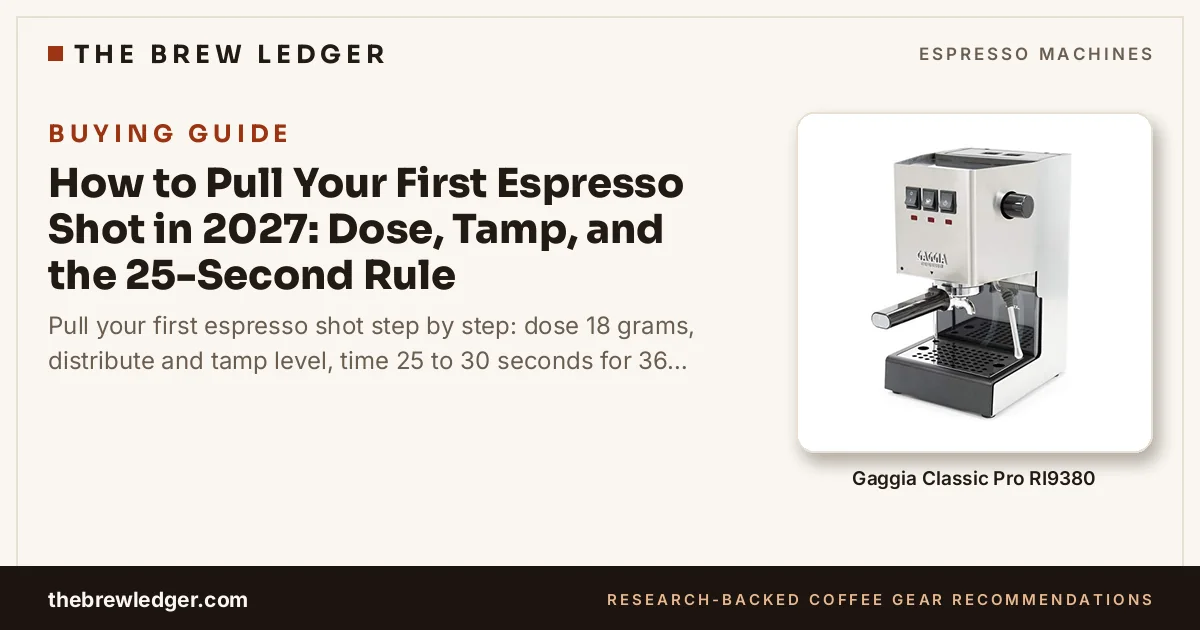
Gaggia Classic Pro RI9380
- Pump: 15-bar ULKA, factory set to 9 bar (E24)
- Portafilter: 58mm stainless steel
- Valve: 3-way solenoid
The Gaggia is the machine to learn on because it hides nothing: a 58mm commercial group, a 3-way solenoid that leaves dry pucks, and a commercial steam wand, with no grinder and no PID to lean on. The current E24 version ships with a brass boiler and a factory 9-bar spring, so the two classic mods are already done. The trade is effort: you supply the grinder, the scale, and the patience, and the machine supplies honest feedback on every one of them.

Best first machine with the grinder built in
Breville Barista Express BES870XL
- Pump: 15-bar Italian pump
- Grinder: Integrated conical burr, 16 settings
- Water tank: 67 oz (2 L)
The Barista Express is the kindest first machine because it removes the hardest purchase: its built-in conical burr grinder feeds a 15-bar pump with low-pressure pre-infusion, and the 67 oz tank outlasts every rival here. A beginner can dose, tamp, and pull without buying a second appliance, and the pre-infusion forgives a tamp that is not yet level. The trade is the grinder itself: it is good enough to learn on and the first thing a serious hobbyist outgrows.

Best budget first machine
DeLonghi Stilosa EC260BK
- Pump: 15-bar
- Boiler: Stainless steel boiler
- Portafilter: 2-in-1: ESE pods or ground coffee
The Stilosa is the cheapest honest entry to a real shot: a 15-bar pump, pressurised 51mm baskets, and a manual steam wand in a body that costs less than a grinder alone. The pressurised baskets forgive pre-ground coffee and rough technique, which is exactly what a first shot needs, and the machine is small enough to live on any counter. The trade is the ceiling: the baskets hide bad technique instead of teaching good technique, so the Stilosa is a trial machine, not a destination.

Best compact first machine
Breville Bambino
- Width: 7.6 in
- Heat-up: ThermoJet, 3 seconds
- Milk: Manual steam wand
The Bambino is the small-counter first machine: a 54mm portafilter, 3-second heat-up, and low-pressure pre-infusion in a body barely wider than a kettle. Its pressurised baskets forgive a beginner the way the Stilosa does, while the fast heat-up means the machine is ready before the grinder is. The trade is capacity: the small tank and single boiler suit one or two drinks, not a household of latte drinkers.
Questions, answered
How much coffee do I use for one espresso shot?
18 grams in a double basket, which yields about 36 grams of espresso. A single basket takes 9 to 10 grams and yields about 18 to 20 grams. Weigh the dose every time: volume measures drift with the grind, and a gram of difference changes the shot time.
How long should an espresso shot take?
25 to 30 seconds from pump start to 36 grams out, including pre-infusion. First drops should appear in 5 to 8 seconds. Faster than 20 seconds is under-extracted and tastes sour; slower than 35 seconds is over-extracted and tastes bitter.
Why is my espresso sour?
Sour means under-extracted: the water ran through too fast to pull the sweetness out. Grind finer, add a gram to the dose, or brew hotter, and change one thing at a time. Stale beans and a cold cup can also read as sour, so rule those out before chasing the grind.
Why is my espresso bitter?
Bitter means over-extracted: the water sat in the puck too long and pulled the harsh compounds behind the sweetness. Grind coarser, stop the shot earlier, or drop the dose a gram. A dirty group or rancid oils in an old grinder can also taste bitter, so clean both before changing the recipe.
Do I need a scale to pull a good shot?
Yes, for repeatability. A cheap kitchen scale that reads to a tenth of a gram is enough: weigh the dose in and the yield out, and the shot time becomes a measurement instead of a guess. Without a scale you cannot tell whether the grind or the dose changed, and every fix becomes a guess.
Can I use pre-ground coffee for espresso?
With pressurised baskets, yes: the Stilosa and the Bambino ship with them, and they build pressure behind a valve so pre-ground coffee still pours a drinkable shot. With non-pressurised baskets, no: pre-ground coffee goes stale in days, grinds too coarse for a standard basket, and the shot gushes through in ten seconds. Buy whole beans and a burr grinder for any standard basket.
What if the shot runs in 10 seconds?
Grind finer first, then check the dose and the tamp. Ten seconds means the water found an easy path: a coarse grind, a light dose, a tilted tamp, or a pressurised basket with a grind that is too coarse for it. Fix one at a time in that order, and pull again. If the grinder cannot go finer, it is the wrong grinder for espresso.
How many shots until it tastes right?
Three to five shots is typical for a new bean on a new machine: the first lands somewhere, the log tells you which direction to move, and the third or fourth lands in the window. Budget a whole bag for learning if the machine is your first, and do not judge a machine on its first shot.
Should I mod my Gaggia before my first shot?
No. The current Gaggia Classic Pro E24 already ships with the two mods older guides told you to fit: a brass boiler and a factory 9-bar OPV spring. Learn the machine stock first; a PID kit is the only mod worth considering later, and only once temperature surfing is the thing holding your shots back.