How to
Pour Over Coffee to Water Ratio: 1:15, 1:16, and 1:17 Explained for 2027
The pour over coffee to water ratio that fits your taste: 1:15 for bolder cups, 1:16 as the starting point, 1:17 for lighter ones, with grams per cup and dripper adjustments.
The short answer
Start at 1:16: 1 gram of coffee for every 16 grams of water, so 22 grams of coffee to 350 grams of water for a two-cup brew. Move to 1:15 if you want a bolder cup and 1:17 if you want a lighter one, and change only the ratio, never the grind at the same time. If the cup tastes sour, the fix is a finer grind or hotter water, not more coffee: strength and extraction are different problems. The sections below give grams per cup, dripper adjustments, and the three-brew test that settles your own ratio.
Choose your ratio in three brews
What the ratio actually means
A 1:16 ratio means 1 gram of coffee for every 16 grams of water. The first number is always the coffee; the second is the water. A smaller second number means more coffee per cup and a stronger brew: 1:15 is bolder than 1:16, and 1:17 is lighter. The ratio decides how much coffee flavour ends up in the water, which is strength. It does not decide how completely each gram is extracted, which is a job for the grind, the temperature, and the pour. Keep the two ideas apart and most ratio arguments dissolve: a weak cup and a sour cup are different faults with different fixes.
Start at 1:16, then move one step
Brew three cups at 1:16 before changing anything. That ratio sits in the middle of the range most pour over guides use, between 1:15 and 1:17, and it suits most medium roasts in a V60 or Kalita. If every cup tastes thin or watery, step to 1:15. If every cup tastes heavy or muddy, step to 1:17. Move one step at a time and brew at least twice at each ratio, because a single cup can mislead: yesterday's grind, the water temperature, and the freshness of the beans all shift the result. The ratio you settle on is personal, not a score: a dark roast drinker often lands at 1:17, a light roast drinker at 1:15.
Grams per cup: the table that ends the guessing
Weigh both sides, every time. A tablespoon of coffee weighs anywhere from 7 to 11 grams depending on the roast and the grind, so volume measures cannot hold a ratio. At 1:16, the numbers are: one cup, 250 grams of water to 16 grams of coffee; two cups, 350 grams to 22 grams; three cups, 500 grams to 31 grams; a full 6-cup Chemex, 750 grams to 47 grams. The 6-cup Chemex holds 30 oz (887 ml), so 750 grams of water leaves headroom for the bloom and the pour. At 1:15, add roughly one gram of coffee per 15 grams of water: 17 grams for one cup, 23 for two, 33 for three. At 1:17, take a gram off: 15 grams for one cup, 21 for two, 29 for three. Write your recipe on the bag or the kettle base until it is habit.
Strength is not extraction: the sour-cup trap
The most common ratio mistake is adding coffee to fix a sour cup. Sour means under-extracted: the water did not pull enough from the grounds. More coffee in the same water makes the cup stronger and still sour, because the extraction fault is untouched. The fix is a finer grind, hotter water, or a slower pour, in that order. The reverse trap is the same: a bitter cup does not need less coffee, it needs a coarser grind or cooler water. Change the ratio only when the cup tastes right in character but wrong in strength: thin but sweet means more coffee; heavy but sweet means less. If the cup tastes wrong in character, the grind and the temperature are the levers, and the troubleshooting in pour over troubleshooting walks through each one.
Adjust the ratio by dripper
The dripper changes how a ratio behaves. In a V60, the cone and large hole make drawdown fast, so 1:16 with a medium-fine grind is the honest starting point, and finer grinds let you hold 1:16 even for light roasts. In a Kalita Wave, the flat bottom slows the water, so the same ratio extracts a little more: start at 1:16 and expect 1:17 to taste fuller than it does in a V60. In a Chemex, the thick bonded filters slow drawdown further and strip oils, so 1:16 to 1:17 with a coarser grind keeps the cup clean without going thin. In a Melitta wedge or the Bodum mesh carafe, start at 1:16 and judge by taste: the wedge is forgiving, the mesh passes fines and oils that read as body, so a 1:17 there can taste as full as a 1:15 in a V60. See the best pour-over dripper ranking for which shape forgives what.
The three-brew test that settles your ratio
Pick one bean and one dripper, fix the grind and the water temperature, and brew the same recipe three mornings running at 1:15, 1:16, and 1:17. Taste each cup at the same temperature, after the same rest, and write one line per cup: thin, balanced, or heavy, and sweet, sour, or bitter. The ratio that reads balanced and sweet twice is yours, for that bean. Change beans and the answer can move a step: light roasts usually want the bolder end, dark roasts the lighter end. Keep the log for a month and the ratio stops being a number from a guide and becomes your recipe, which is the whole point of pour over.
Three tools for a repeatable ratio

For the most control over the ratio
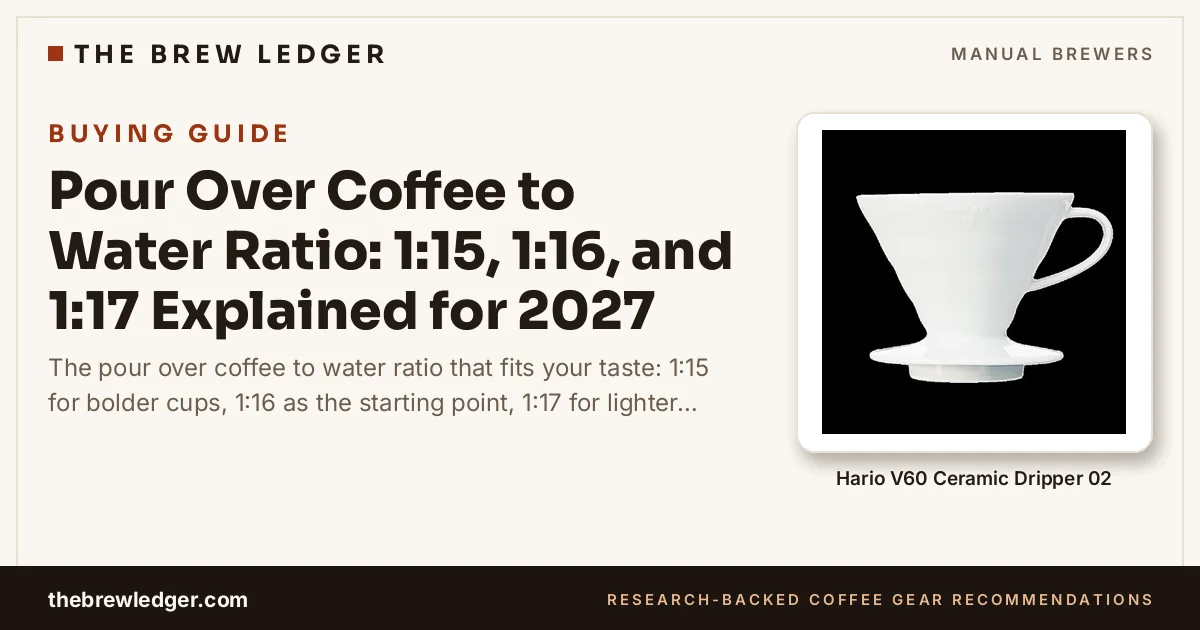
Hario V60 Ceramic Dripper 02
- Dripper shape: Cone with spiral ribs
- Drip hole: Single large hole
- Size: 02 (1 to 4 cups)
The V60 rewards exact dosing: its cone and large single hole make the drawdown respond directly to how much coffee and water you use, so a ratio change shows up in the cup immediately. Pair it with a scale and the Fellow Stagg EKG Pro and the recipe becomes repeatable. Read the full Hario V60 review and the best pour-over dripper ranking.
For weighing and pouring precisely
Fellow Stagg EKG Pro Electric Kettle
- Capacity: 0.9 liters
- Power: 1200 watts
- Temperature range: 104 to 212 F (40 to 100 C)
Scheduled heating, a brew stopwatch, and to-the-degree control mean the water side of the ratio is exact every morning, and the precision spout keeps the pour rate steady enough that the ratio is the only variable changing. Read the full Stagg EKG Pro review and the best pour over kettle ranking.

For the most forgiving ratio
Kalita Wave 185 Stainless Dripper
- Dripper shape: Flat bottom
- Drip holes: Three small holes
- Size: 185 (1 to 4 cups)
The flat bottom and three small holes slow the drawdown and forgive a gram or two either way, so a beginner who is still learning to weigh can start at 1:16 without the cup falling apart. Read the V60 versus Kalita Wave comparison and the best pour over coffee makers ranking.
Questions, answered
Is 1:16 the best ratio for pour over?
It is the best starting point, not a universal answer. Most medium roasts taste balanced at 1:16 in a V60 or Kalita, which is why guides quote it. Light roasts often taste better at 1:15 and dark roasts at 1:17. Brew at 1:16 first, then move one step in the direction the cup asks for.
How many grams of coffee do I need for one cup?
16 grams of coffee to 250 grams of water at 1:16, which is a standard single mug. For a smaller 200-gram cup, use 12 to 13 grams. Weigh the water too: a mug filled to the brim is not 250 grams, and the error is the whole recipe.
Does adding more coffee fix a sour cup?
No. Sour means under-extracted, and more coffee makes a stronger sour cup. Grind finer, use hotter water, or pour more slowly, and keep the ratio fixed while you fix the extraction. Add coffee only when the cup tastes sweet but thin.
Should the ratio change for dark roasts?
Usually, yes, by one step toward 1:17. Dark roasts extract more easily and carry more soluble material, so the same ratio tastes heavier and can turn bitter. Start at 1:16, and if the cup tastes heavy or ashy, move to 1:17 before touching the grind.
Do I need a scale, or can I use scoops?
You need a scale for a repeatable ratio. A level tablespoon of coffee weighs 7 to 11 grams depending on roast and grind, so two scoops can be 14 grams or 22, and no recipe survives that range. A kitchen scale that reads to a gram costs little and is the single best pour over purchase after the dripper itself. See how to choose a pour over coffee maker for the setup order.
What ratio works best in a Chemex?
Start at 1:16 with a coarser grind than you would use in a V60, and expect 1:17 to taste clean rather than thin, because the thick filters slow the drawdown and the brew runs longer. If the cup tastes weak at 1:17, move to 1:16 rather than grinding finer: the filter, not the ratio, is doing the slowing. The Chemex Classic review covers the filter cost and the cleaning trade.
How do I keep the ratio the same when I brew for guests?
Scale the recipe, do not guess it: multiply both sides by the same factor. Four cups at 1:16 is 500 grams of water to 31 grams of coffee, and a 6-cup Chemex is 750 grams to 47 grams. Keep the grind the same and extend the pour in stages rather than dumping the water in at once, so the bed stays level and the drawdown time stays near the single-cup time. The best pour over coffee makers ranking shows which brewers hold a full batch without stalling.